In checking my blog "stats," I discovered that some people have found my blog recently by Googling how school psychologists present at Committee of Special Education (CSE) meetings. First, I have to thank Google, or as I call it "The Googs," for helping people find my blog. Hi friends, welcome to the party!
Second, I'll give you a rundown of how a CSE meeting typically goes in my building. I posted a
brief ditty about CSEs at the beginning of the year, but I'll get more in depth now for those who are interested and Googling their hearts out.
CSEs meet for initial referrals for special education services or if changes need to be made to a student's program, such as adding or removing services, changing a student's classification, or moving a student to a different classroom placement. In my building, the CSE chairperson, school psychologist (me!!), social worker, child's special education and general education teachers, and child's parent(s) are invited. The parents also may bring whomever they choose, such as an outside counselor or another family member. Unfortunately in my district, not many parents attend (nature of the urban, inner city beast).

We tape our CSE meetings with a handheld tape recorder. It's much easier than trying to write or type minutes during the meeting, while attempting to keep up with what's actually going on and being discussed. Plus, it holds everyone at the meeting accountable for what was agreed upon. The meetings begin with introductions of everyone in attendance, then the parent reports about the child's progress or concerns. The social worker provides information regarding developmental milestones, family life, and other life concerns and how they might relate to the child's school-life. The teacher provides information about the reason for referral, how the child is doing in the classroom, their concerns, and the child's academic and behavioral functioning.
Then we get into the meat of the meeting: the evaluations. As
previously discussed in my blog land, most CSE meetings contain two assessments, the achievement and cognitive. These measure a child's potential to learn (the cognitive, my domain) and what they actually have learned (the achievement).
I always begin my report at CSE meetings with behavioral observations. Typically, I observe a child in the classroom before giving the cognitive test to see how the student works, solves problems, and interacts with peers and adults. I also document these same behaviors during the actual assessment. I discuss the child's work habits, frustration levels, effort and motivation, etc before getting into the juicy test findings.
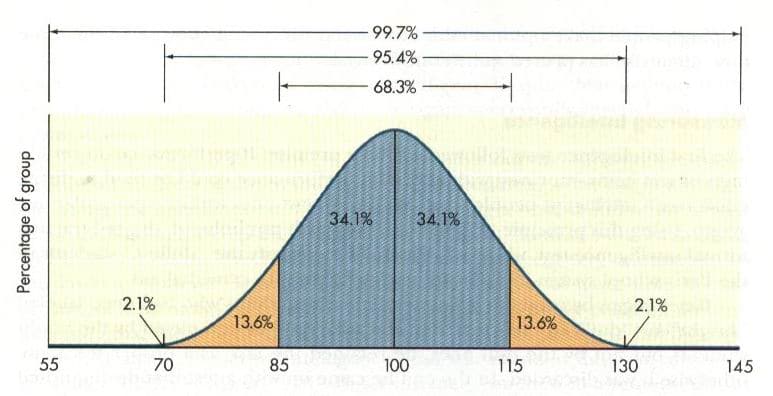
My description of the cognitive testing results depends on what assessment I give. Typically, the assessment I administer produces one overall Full Scale Intelligence Quotient (FSIQ) score that is a combination of four areas--verbal comprehension, perceptual reasoning, working memory, and processing speed. To start, I describe the FSIQ and where it falls in relation to the child's other same age peers (i.e. is the child
Average intelligence?). I describe each of the four areas, what they measure, and how the child performed on each task subsumed beneath them. I try and describe tasks in as plain of language as possible, so that the teachers and parents understand what exactly is being measured. For instance, instead of saying something like "nonverbal part-whole synthesis ability," I'll say "ability to assemble puzzles and replicate a pattern." Makes more sense, eh?

I also point out any strengths/weaknesses, oddities, discrepancies, or scatter, and if they are related to anything I observed behaviorally from the child. If a child performs averagely on one working memory task, but bombs the second, what does it mean? If the child has average verbal comprehension but extremely low perceptual reasoning, why does it matter? I try to describe in terms of what the child can do or is "good" at, and then what they may struggle with. In the working memory case, I might say something like, "Tammy has strong memory skills when asked to remember simple, rote information, but might have difficulty when she has to both remember information and also put facts in order or recall information at a later date." I
always discuss positive points with negative ones. Nobody wants to listen to everything the child has trouble with or can't do. Special education is not about how or what a child
can't learn, but how they learn
differently.
In my building, my CSE chair reports the achievement testing and she discusses strengths & weaknesses in regards to basic, intermediate, and comprehensive reading, writing, and math skills. After she describes the achievement scores, I will relate my test results back to hers. I point out any similarities between the achievement and the cognitive. I also discuss what the implication the cognitive results will have for the student's academic achievement. For instance, if a child does have poor "nonverbal part-whole synthesis ability," meaning that they have trouble putting parts together to make a whole product, they may have difficulty in reading. Letters and letter sounds are put together to make words, words are put together to make sentences, etc... and all result in a final synthesis into something that has meaning or comprehension. Capice?
After hearing from the teacher(s), parent, social worker, and all the test results, we discuss the outcome of the meeting. If it is an initial referral, the psychologist (me again!!) will provide evidence for or against special education services and will suggest an educational disability classification for the child (one of
thirteen possible classification areas). Discussion ensues, and if the parent and CSE agree to classification, then an Individual Education Plan (IEP), including goals, testing accommodations, and program modifications will be developed. These are designed to "even the playing field" between the general education children and the child in special education, so that they can access and benefit from the curriculum equally. We then all say we agree to what was discussed and developed (aye), turn the tape off, run to the restroom, and get ready for the next meeting.
Now you know... and knowing is half the battle. Knowing also takes away the mystery of what goes on behind closed doors that have "CSE Meetings in Progress, Do Not Enter" signs on them. Our magic spell is broken!